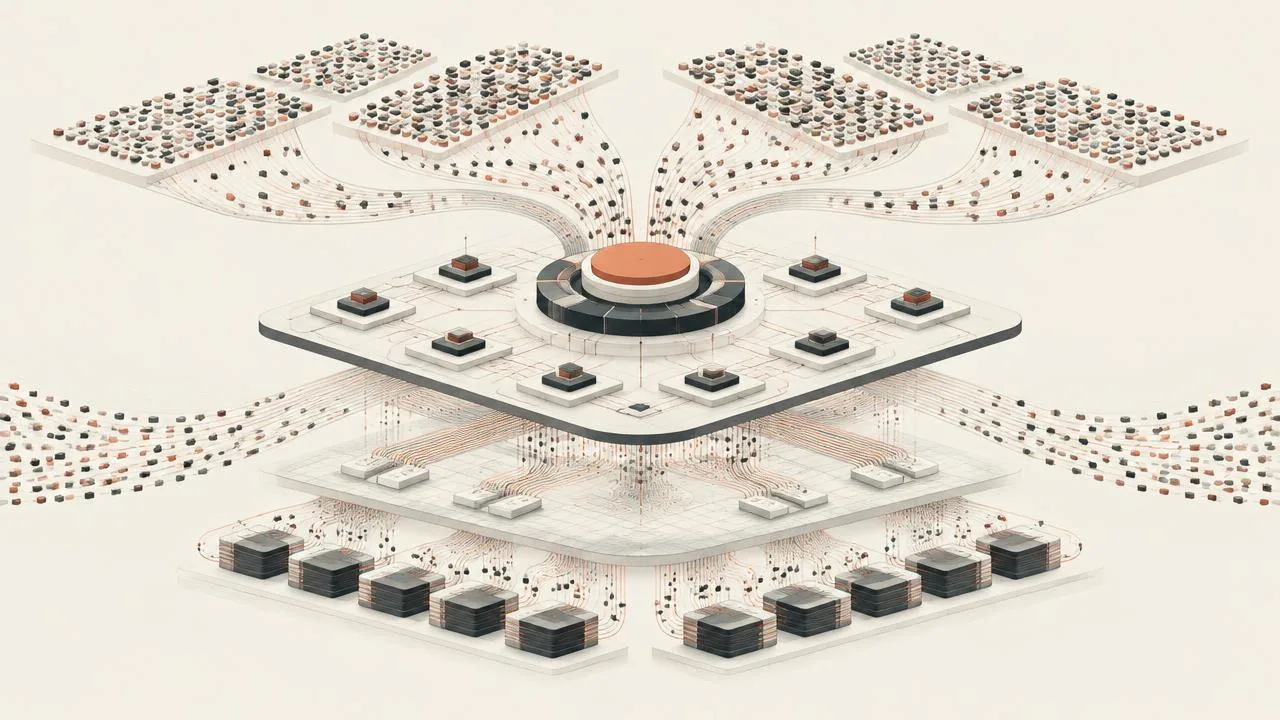
On October 14, 2026, OpenAI published a case study of Third Moment Research, a startup developing AI systems capable of conducting computational investigations with limited human intervention. The company reports operating 10,000 agents concurrently, maintaining research sessions for 36 to 48 hours, and consuming one trillion OpenAI tokens in a single day.
Third Moment's initial application is quantitative finance. Its agents investigate trading strategies using historical market data, source-code repositories, GPU-supported machine learning infrastructure, and simulation tools. They can formulate hypotheses, implement experimental changes, evaluate results, and use those results to decide which experiments to conduct next.
What makes the announcement interesting is the infrastructure surrounding those agents. Third Moment does not rely entirely on a language model to manage its own execution. Instead, it runs Codex inside a supervisory system that examines incomplete investigations and decides whether work should continue, terminate, or require human intervention.
The distinction matters because an autonomous research session is not a conventional model inference request. It is a sequence of dependent computational operations, some of which may take hours, fail unexpectedly, or produce results that are difficult to interpret. Maintaining that process across thousands of simultaneous executions requires considerably more engineering than simply increasing API concurrency.
What Third Moment has actually demonstrated
The company's reported figures describe several different dimensions of system performance. They should not be treated as interchangeable measures of agent intelligence or reliability.
| Reported measurement | Result | What it establishes |
|---|---|---|
| Concurrent agents | 10,000 | Scale of parallel agent execution |
| Autonomous research sessions | 36–48 hours | Duration of sustained investigations |
| OpenAI token consumption | 1 trillion/day | Scale of model usage across the workload |
| Backtesting optimization | ~3 hours to 3–5 minutes | Improvement to a particular computational bottleneck |
| Security testing | Daybreak | Automated testing of research-environment isolation |
Source: OpenAI, October 14, 2026. These are company-reported results, not independently audited reliability metrics.
The important omissions are equally instructive. OpenAI does not report the percentage of investigations that complete successfully, the average number of retries, the frequency of human intervention, or the cost per validated research result. Nor does it disclose the complete scheduling, checkpointing, and distributed-state infrastructure behind the 10,000-agent system.
Those are precisely the measurements an engineering team would need before determining whether a similar architecture was suitable for its own production workloads.
An execution system with two levels of control
For quantitative research, Third Moment runs the Codex harness inside Dockerized environments. The agents receive access to a research repository, approximately a terabyte of data, documentation, and modules for feature engineering, model training, and simulation.
The Codex harness provides the operational capabilities required to investigate a problem: reading and modifying code, invoking tools, creating plans, launching subagents, and compacting context as the investigation grows. GPT-6 Astra, GPT-6 Sol, and GPT-6.1 Sol provide the reasoning capabilities used during the research.
The more significant architectural choice is the second harness surrounding Codex. Powered by GPT-6 Sol or GPT-6.1 Sol, this supervisor examines the recorded execution trajectory when an investigation is left unfinished. It can then determine whether another attempt is justified, whether the work should stop, or whether a human needs to review the situation.
Figure 1: Conceptual reconstruction of the reported execution architecture
flowchart TD
    A["Research Objective"] --> B["Supervisory Harness"]
    B --> C["Codex Agent"]
    C --> D["Isolated Research Environment"]
    D --> E["Source Code and Data"]
    D --> F["Simulation / Model Training"]
    D --> G["Subagent Investigations"]
    E --> H["Execution Results"]
    F --> H
    G --> H
    H --> I{"Task Completed?"}
    I -->|"Yes"| J["Validate and Record Results"]
    I -->|"No"| K["Inspect Execution Trajectory"]
    K --> B
    B --> L["Retry / Terminate / Human Review"]
The diagram illustrates the components described in the case study. It does not imply that Third Moment has disclosed this exact topology or its underlying scheduler.
This division between execution and supervision has implications beyond quantitative finance. An engineering agent modifying a large repository, a security agent investigating vulnerabilities, or an analytical agent running a sequence of data-processing jobs will encounter similar problems.
In each case, completing the assigned work and managing the lifecycle of that work are distinct responsibilities. The latter requires understanding failures, preserving intermediate results, enforcing limits, and deciding when further computation is no longer worthwhile.
Our technical breakdown of multi-agent orchestration examines what the disclosed architecture tells us—and what a production scheduler still needs to provide.
The infrastructure can become the bottleneck
One of the clearest examples in the case study concerns an inefficient trading simulation.
Third Moment discovered that a backtest covering a year of order-level US equity data required approximately three hours to complete. During that period, agents repeatedly checked whether the simulation had finished. These checks consumed tokens and filled their context with status messages that contributed little useful information to the investigation.
Codex analyzed thousands of recorded execution trajectories, their timestamps, and the underlying codebase. It identified caching and memory-packing optimizations that reduced the backtest to approximately three to five minutes.
That represents a roughly 36–60× speedup, depending on the final runtime.
The improvement has two consequences. First, agents can conduct substantially more experiments within the same research window. Second, they spend less time consuming tokens while waiting for external computations to finish.
This illustrates a problem that may become increasingly important in agent infrastructure: a highly capable model can still be limited by inefficient tools, blocking operations, or poorly designed execution workflows.
We examine this in Why AI Agents Waste Tokens While Waiting for Tools.
Long-running execution introduces unfamiliar reliability problems
A research agent operating for 48 hours may generate hundreds of experimental results, launch subagents, modify source code, and accumulate substantial amounts of execution history.
Keeping that information in the model's context indefinitely is not practical. Third Moment uses Codex's context-compaction capabilities, but conversational context is only one component of the state required for reliable execution.
A production research system also needs durable records of completed experiments, task dependencies, source-code versions, evaluation results, and unresolved operations. Without them, a failed execution process could lose hours of valuable work even if the language model retained a reasonable summary of the investigation.
These concerns are familiar from distributed workflow systems. What changes with agents is that portions of the workflow are designed dynamically. The model can decide to create additional work after execution begins, making resource management, state consistency, and recovery more complicated.
Our articles on long-running agent state management and agent failure recovery examine these problems in detail.
Security and evaluation are part of the architecture
Third Moment also uses OpenAI's Daybreak cybersecurity platform to test whether agents can escape their research environments and access the wider network.
This is a significant consideration because agents capable of executing code can interact with resources beyond the language model itself. Their actions must remain subject to independently enforced permissions, even when those actions appear useful for completing a task.
Security is only one side of the problem. The research results must also be evaluated correctly. An agent that finds a profitable strategy in historical data has not necessarily discovered a strategy that will perform well on unseen data. Running more experiments increases the risk of statistical overfitting unless evaluation procedures account for the number of hypotheses being tested.
We explore these issues in How to Secure Autonomous AI Agents and How Self-Improving AI Agents Actually Work.
What comes after 10,000 agents?
Third Moment's stated ambition is to scale toward hundreds of thousands of collaborating subagents, with chains of dependent experiments and feedback loops that improve the system over time.
That is a different challenge from running thousands of independent investigations. Collaborating agents must coordinate shared resources, preserve dependencies, resolve conflicting changes, and determine whether results from one experiment invalidate work already performed elsewhere.
The current announcement provides evidence of substantial progress in large-scale execution, but not a complete demonstration of that future collaborative architecture.
For engineering teams, the value of the case study is that it exposes the infrastructure questions likely to matter as autonomous systems become more common. Model capability will continue to improve, but reliable autonomy will also depend on schedulers, state stores, evaluation systems, execution monitors, security boundaries, and recovery policies.
The central question is no longer only whether a model can decide what to do next. It is whether the surrounding system can execute that decision reliably, preserve the result, and determine what should happen when something goes wrong.
Primary source: OpenAI — How Third Moment Research runs 10,000 agents for 36+ hours.