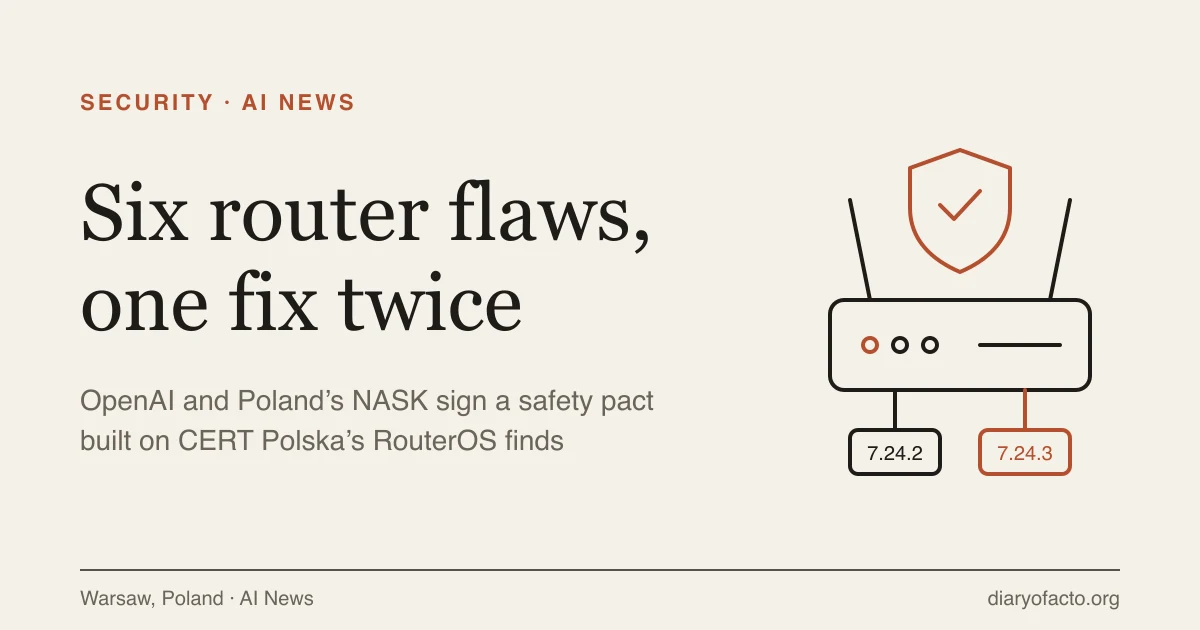
OpenAI and Poland’s NASK National Research Institute signed an agreement on October 23, 2026 to explore joint AI safety, security and technical research, and OpenAI’s showcase for the OpenAI NASK partnership is six MikroTik RouterOS vulnerabilities that CERT Polska found with help from OpenAI models. CERT Polska’s own advisory adds a detail the announcement leaves out: one of the six needed a second patch release, because the vendor’s first fix was incomplete.
The OpenAI NASK Agreement Is a Framework for Joint Testing
The agreement pairs OpenAI with NASK’s AI Safety Research Center, which serves as the Polish AI Safety Institute, to evaluate increasingly capable systems, look for vulnerabilities and strengthen safeguards. OpenAI’s announcement lists no budget, model list or deliverables. It places the deal alongside the company’s existing work with the US Center for Advancing Standards and Innovation for Super Intelligence and the UK AI Security Institute, and repeats its call for shared international methods to evaluate capabilities, test safeguards and report incidents. NASK director Radosław Nielek said in the announcement that safety “cannot be achieved in isolation,” and described the center’s focus on detecting synthetic content and its multilingual misuse.
CERT Polska Used Daybreak Models to Find Six RouterOS Flaws
The concrete evidence predates the signing. In July, CERT Polska, the national incident response team that operates inside NASK, gained access to OpenAI’s cyber-capable models through the Daybreak program. OpenAI says the team used those models to help discover six vulnerabilities in MikroTik RouterOS, including flaws that could be chained to take over devices without authentication. CERT Polska published all six on September 5, 2026, crediting its researcher Sławomir Rozbicki. They include an SSH authentication bypass, CVE-2026-67276, where RouterOS checked an RSA key’s modulus but ignored its exponent, and CVE-2026-86060, a privilege escalation through crafted SSH usernames. Two days later, BleepingComputer reported that CERT Polska had seen attackers chaining those two flaws to take full control of routers with SSH exposed to the internet.
One of the Six RouterOS Fixes Was Incomplete on First Release
OpenAI’s announcement says MikroTik released fixes and CERT Polska confirmed they prevented the attacks it observed. The advisory shows that the fix was not a single event. Five of the flaws are fixed in RouterOS 6.49.21, 7.23.4 and 7.24.2. The sixth, CVE-2026-67278, lets RouterOS accept malformed RSA signatures, and because its trust store includes a root certificate with exponent three, an attacker who controls an outbound TLS connection can forge a trusted intermediate and impersonate any host. CERT Polska states that 7.23.4 and 7.24.2 contained an incomplete fix for it, credits Robert Żegleń for reporting that, and lists 7.23.6 and 7.24.3 as the releases that actually close it. A team that upgraded to 7.24.2 when the advisory first landed would have closed the actively exploited SSH chain and still carried the certificate forgery flaw.
Why This Matters for Engineering Leadership
AI-assisted vulnerability research is moving from labs into national CERTs, and the NASK case shows the discovery step speeding up while the remediation step stays as slow and error-prone as before. Your intake process needs to treat “patched” as a claim to test. For every advisory that touches your fleet, record the exact fixed version per CVE, since one advisory can carry different fixed versions for different flaws, and alert on the gap between the installed version and the required version for each CVE. Re-run the original proof of concept or the vendor’s detection after patching, because the first CVE-2026-67278 fix shipped incomplete and, according to CERT Polska, came to light when Robert Żegleń reported it. Watch for revisions to advisories you have already closed, since a later fixed version can supersede the one you installed. If your own teams start using frontier models for security research, budget the human verification time on the remediation side before you scale up the finding side.
FAQ
What did OpenAI and NASK agree on October 23, 2026?
They signed an agreement to explore collaboration on AI safety, security and technical research. NASK’s AI Safety Research Center, which serves as Poland’s AI Safety Institute, will work with OpenAI on evaluating capable systems and strengthening safeguards.
What is Daybreak?
Daybreak is the channel through which OpenAI gives cyber defenders access to its cyber-capable models. CERT Polska gained access through it in July 2026.
How many MikroTik RouterOS vulnerabilities did CERT Polska find?
Six, published on September 5, 2026 as CVE-2026-67276, 67277, 67278, 67279, 67281 and CVE-2026-86060. OpenAI says its models helped discover them.
Which RouterOS versions fix the six vulnerabilities?
CERT Polska lists 6.49.21, 7.23.4 and 7.24.2 for five of them. CVE-2026-67278 needs 7.23.6 or 7.24.3, because the earlier 7.x releases contained an incomplete fix.
Were the RouterOS flaws exploited in the wild?
Yes. BleepingComputer reported on September 7, 2026 that CERT Polska saw attackers chaining CVE-2026-67276 and CVE-2026-86060 to take full control of routers with SSH exposed.
What should security teams take from the NASK case?
Verify AI-assisted findings against the advisory’s exact fixed versions and re-run the original attack, because a vendor patch can be incomplete even when the release notes say fixed.