Stolen AI Keys From the Railway Breach Ran Up $740,000, and Each AI Provider Set Its Own Refund Rule
Railway’s incident report lists six AI providers and four refund answers for $740,000 of unauthorised spend. AWS and Google are refunding, OpenRouter refused, and Railway is covering the gap.
Read the story
ENISA’s AI Code Review Found 220 Issues in EU Software, and Code Owners Had Checked Only 88 Three Months Later
ENISA and CERT-EU ran frontier models over 27 EU codebases for about €6,649 and got 220 findings. By November 12, owners had assessed 88, confirming 95%, while NATO scales the same class of models.
Read the story
EY’s Agentic Cyber Defense Center Records the Authority Behind Every Security Agent Action
EY launched its Agentic Cyber Defense Center with Microsoft on November 18, applying policy controls and tamper-evident records to AI security agents. The authority rules those records enforce are still the buyer’s to write.
Read the story
Microsoft Perception Goes GA, and Its Agent Discovery Now Counts Your Engineers’ Coding Agents
Microsoft made Perception generally available at Ignite on November 17. In preview, its agent discovery now recognises 60 local agent types, including Claude Code, Codex and Copilot, and gives each an Entra identity.
Read the story
CommBank CodeCheck Is an AI Code Review Harness That Treats the Code It Reads as Hostile
Commonwealth Bank released CodeCheck, a free MIT-licensed security review plugin for Claude Code and Codex. Its README says prompt guardrails are not a security control and tells teams to run it in a sandbox.
Read the story
United Blocks AI Booking Agents That Use Customer Logins, While JetBlue Says Airlines Should Adapt
United said on November 11 it will stop unauthorized AI assistants from booking on its apps and through agencies, citing shared passwords, MileagePlus miles and FAA check-in rules. JetBlue’s president said airlines should adapt.
Read the story
UPS Is Using AI to Find Alternative Aircraft Parts, and Every Suggestion Still Has to Clear Approval Records
A UPS aircraft engineering manager told an IFS panel that alternative parts have been a focus for a year. FAA PMA records tie each approved part to specific aircraft, and 58% of respondents to Oliver Wyman’s MRO survey say their AI work is still experimental.
Read the story
Anthropic’s Singapore MOU Puts Model Evaluation and Incident Response on the Table With Government
Anthropic opened its fifth Asia-Pacific office and signed an MOU with Singapore covering evaluation, testing standards and incident response. GovTech already has 1,500 engineers on Claude Code.
Read the story
Singapore’s On-Device Scam Detector Keeps Messages on the Phone, and Its First App Can Only Warn
GovTech and Google DeepMind fine-tuned Gemma to run scam detection on the handset. The first app, AntiScam Pango, launched in beta on November 4 and can warn users but cannot block messages.
Read the story
US States Enacted 280 AI Bills in 2026, and the Only Two Broad Laws Both Require Telling People When AI Is Involved
NCSL counts 1,539 state AI bills introduced in 2026 and 280 enacted. Colorado SB 189 and Connecticut SB 5, the two broad laws, both turn on AI notice. Colorado’s starts January 1, 2027.
Read the story
Sarawak’s Voice AI Helpdesk Trial Took 4,056 Calls, and Only 1,225 of Them Were Real ICT Incidents
SAINS and 8nabler plan more voice AI trials before any government rollout. Their pilot reports calls and minutes, and no one has said how many of the 1,225 real incidents the AI resolved.
Read the story
Microsoft’s MAI-DxO Beat Doctors on Emergency Cases in Science, and Its Benchmark Puts a Price on Every Test the AI Orders
MAI-DxO scored 80.3% on emergency admissions and 83.2% on NEJM cases in a Science paper, against 46.8% and 36.1% for generalist doctors. Its benchmark charges for every test, a model for agent evals.
Read the story
Germany’s Industrial AI Declaration With NVIDIA Builds on Factory Data, So Manufacturers Need Data-Sharing Terms First
Germany and NVIDIA agreed on October 19 to build open physical AI models on Nemotron and Cosmos, with no budget or timeline. Merz asked the Mittelstand to open its data. Set terms before you do.
Read the story
The UK’s AI Sovereignty Plan Advice Sorts Each Layer Into Own, Collaborate or Secure Access, and Engineering Teams Can Run the Same Map
The Council for Science and Technology’s letter to the AI minister asks for a map of compute, data, skills and models that decides what the UK owns, shares or rents. It sets no budget or deadline.
Read the story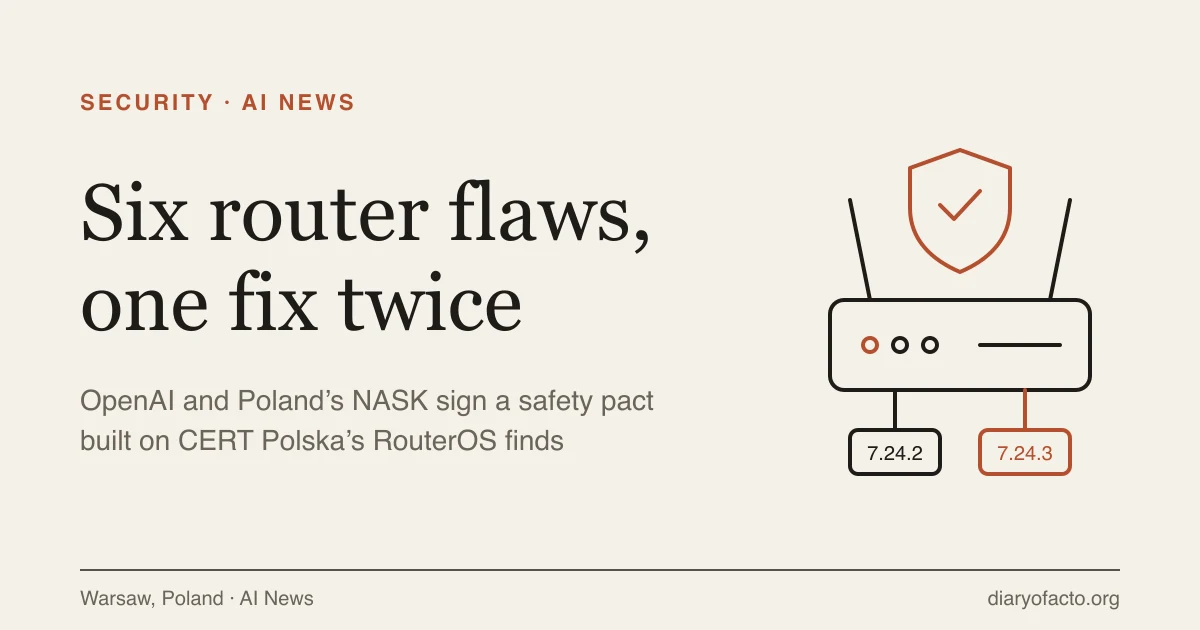
OpenAI’s NASK Safety Deal Builds on Six AI-Assisted RouterOS Finds, and One Fix Needed a Second Release
CERT Polska used OpenAI’s Daybreak models to help find six MikroTik RouterOS flaws. Its advisory shows the first fix for CVE-2026-67278 was incomplete and needed 7.23.6 or 7.24.3.
Read the story
Microsoft’s Exit From Nscale’s Essex AI Data Centre Shows a Grid Connection Date Can Outweigh a £2bn Plan
Microsoft left Nscale’s Loughton site after UK Power Networks said its connection would miss 2026. Reports put enough grid power in the early to mid-2030s.
Read the story
Wells Fargo’s AI Agent Terms Take Effect November 24, and They Make Customers Keep Proof That They Switched Their Agents Off
Section 15 of Wells Fargo’s updated Online Access Agreement treats AI agent instructions as the customer’s own without verification, and requires customers to keep evidence that they revoked an agent.
Read the story
Ohio State’s Microsoft Deal Puts Its EHR Backup and Up to 80% of Compute on Azure, So Recovery Now Runs Through One Vendor
The Wexner Medical Center’s five-year Microsoft partnership aims to move 70% to 80% of storage and compute to Azure and puts the EHR backup there too. The release names no recovery targets.
Read the story
New York’s Frontier AI Testing Center Will Help Regulators Read Developers’ Safety Frameworks Before the RAISE Act Starts
New York’s new center at SUNY Binghamton pairs more than 80 researchers with Empire AI compute. It will help DIGIT review the safety frameworks frontier developers must publish from January 2027.
Read the story
UnitedHealthcare’s Avery Resolution Rate Counts Conversations That Never Reached a Human, and That Is a Different Number From Answers That Were Right
UnitedHealthcare opened Avery to 21 million members citing a 90% resolution rate. It defines that rate as inquiries with no transfer to an advocate, and has not published accuracy results.
Read the story
Gemini for Healthcare Agents Read Epic Charts Without Writing Back, So the Connectors That Act Need Their Own Audit
Google Cloud’s Gemini for Healthcare preview keeps its Epic and Oracle Health links read-only. Its agents still run eligibility, benefit and prior authorization workflows, and those connectors need the same scrutiny.
Read the story
India’s DEPA for AI Training Draft Keeps Data in Sealed Enclaves, Except Under the Option That Lets Developers Download It
MeitY’s draft framework for pooling bank and hospital data promises training without raw-data exposure. Its first deployment option lets developers download provider-anonymised datasets, which moves the privacy risk back to providers.
Read the story
Clalit’s Voice AI Assistant Gets $2 Million From Google.org for Two Years, and No One Has Said Who Pays After That
Google.org is funding a Gemini voice assistant that Clalit’s 5 million patients can reach by landline. The grant covers the build through launch. Neither side has said how it will be paid for after two years.
Read the story
Meta Says US Data Center Builds Get Harder After the Midterms, and Hyperscalers Are Weighing Sites Abroad
Meta’s president told WSJ Tech on November 4 that every new US data center will face more local review. For engineering teams, cloud capacity now carries a permitting risk and a data residency question.
Read the story
Congressional Office of Technology Bill Would Give Any Lawmaker Technical Answers in 14 Days, Including Reviews of Model Claims
H.R. 10946 would revive the defunded OTA with a 14-day technical answer guarantee for any member. Its definition of technical assistance covers reviewing claims, data and models, though the bill carries no funding.
Read the story
ADNOC’s OpenAI Frontier Deal Puts One Agent Layer Over 200 AI Applications, and Leaves Human Oversight Undefined
ADNOC will use OpenAI Frontier to coordinate agents above its existing AI, starting with field planning and barrel valuation. It named no timeline, no targets and no definition of a consequential decision.
Read the story