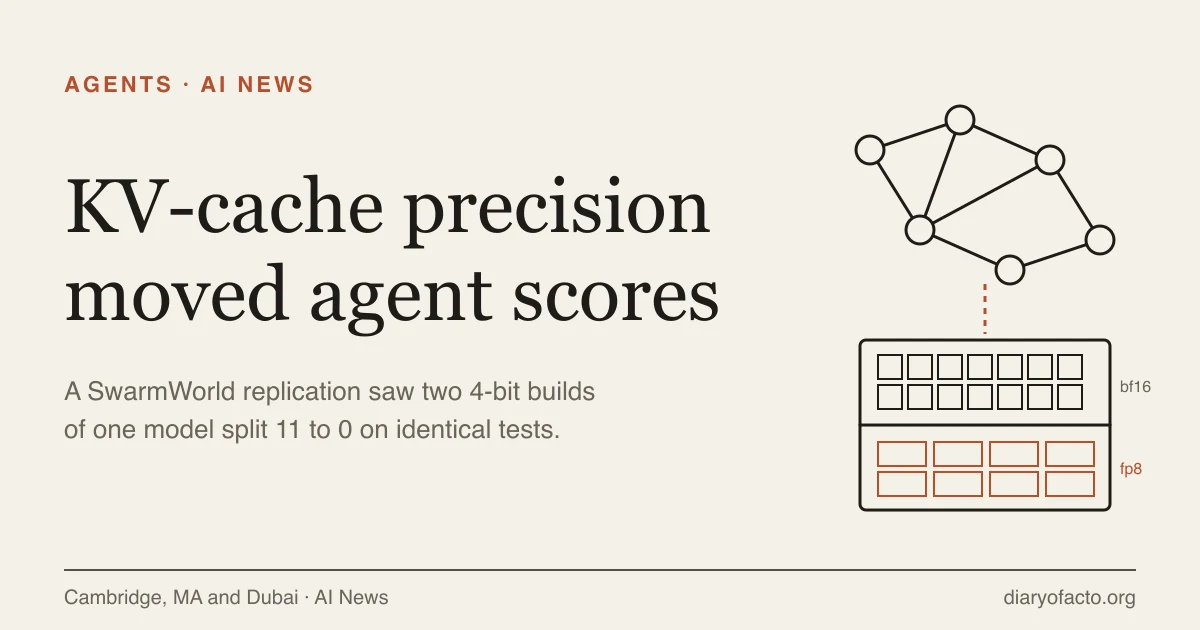
An independent SwarmWorld replication reproduced the central result of MIT’s agent society study on a 4-bit open-weight model and four consumer GPUs, and found that one serving setting moved agent scores further than the gap between a 27-billion and a 235-billion-parameter model. Časlav Nedeljković of HAL8’s AI Local Lab in Dubai published the replication paper in October 2026, and AI News reported it on October 23. Two 4-bit builds of the same model split 11 to 0 across 16 paired test cells, and the leading suspect is a KV-cache precision setting that one checkpoint selected on its own. For anyone comparing agent platforms, that makes serving configuration part of the experiment.
The SwarmWorld Replication Reproduced MIT’s Central Result With Open Weights
The SwarmWorld replication confirmed MIT’s main finding at the 50-agent scale using the original code and commands unchanged. SwarmWorld, posted to arXiv in August 2026 by Subhadeep Pal, Fiona Y. Wang and Markus J. Buehler, places societies of language-model agents in a deterministic simulated world where they gather materials, test recipes and build persistent artifacts. It compares societies that can message each other and inherit each other’s programs against the same number of agents working alone, and MIT ran it on a hosted frontier model with its engine, prompts and traces published on GitHub. Nedeljković swapped in Qwen3.8-27B quantised to 4 bits with GPTQ, served on four RTX 3090 cards, and ran the 50-agent row over MIT’s four world seeds in about 26 hours. Nine of the twelve seed-paired effects matched MIT’s in direction, including every portfolio-resilience gain, and the spatial self-organisation result reproduced in full. The smaller model was the weaker solo agent, reaching 6 of 16 research milestones against 7 to 10 for MIT’s model, and the stronger society member, reaching 16 against 14. The paper reports this as one run at one population size.
Two 4-Bit Builds of the Same Model Split 11 to 0 on Identical Tests
The largest effect in the replication came from serving numerics, ahead of any choice of model. Before the main run, Nedeljković screened candidate models with the validity pilot that MIT’s repository specifies for local models: 16 cells covering four conditions, two population sizes and two seeds. Two 4-bit builds of the same Qwen3.8-27B weights scored mean research scores of 0.24 and 0.41. On identical conditions, seeds and prompts, the GPTQ build scored higher in 11 cells, equal in 5 and lower in none, and built 8 artifacts across four conditions where the other build built 2 in one. The paper notes each cell is a single sample at temperature 0.7, and argues that an 11 to 0 split over 16 paired cells is too lopsided to be sampling noise. The gap between the two builds was larger than the gap the replication measured between the 27B model and Qwen3-235B-A22B, a 235-billion-parameter mixture-of-experts model run at 2-bit precision.
An fp8 KV Cache Shipped With One Checkpoint Is the Leading Suspect
The weaker build’s checkpoint carried its own KV-cache quantisation scheme, and the inference server applied it without being asked. The KV cache stores the attention keys and values for every token already in context. The INT4 checkpoint specified 8-bit fp8 storage with static per-tensor scales, and vLLM honoured that, so every token of its 5,000 to 15,000-token agent contexts was stored and read back at 8-bit precision. The GPTQ build’s cache stayed at 16-bit bf16. The symptoms point to precision lost in context: the fp8 build wrote shorter plans, averaging 885 output tokens per call against 1,162, used fewer of the action schema’s verbs, and fell further behind in the 16-agent cells where prompts run longer. The paper is explicit that the case is unproven. The two builds also used different weight quantisation recipes, and a control run forcing the INT4 checkpoint’s cache to bf16, estimated at about half a day on one 24 GB card, is listed as work in progress. Its conclusion holds either way: KV-cache precision has to be reported next to weight quantisation, because it moved the same model two rungs on the screening ladder. The replication also found that MIT’s released traces reproduce every event, prompt and metric on the released engine but fail one hidden state checksum, which it attributes to code drift inside a single declared engine version. Both findings were reported to the MIT authors.
Why This Matters for Engineering Leadership
Agent evaluations run long, multi-step workloads, and this replication shows that small numeric choices in serving can compound across them until they outweigh the model comparison a team set out to make. Treat the serving stack as part of the model under test. Every agent evaluation manifest should record the model revision, the weight quantisation recipe, the KV-cache data type, the attention backend, the context length, and the inference server’s version and flags. The replication asks MIT to add exactly the KV-cache type and attention backend to its local-model guidance, and to write the server’s reported model name and version into each trace header. If you self-host, read each checkpoint’s configuration for a bundled cache scheme before serving it, since vLLM will apply one silently. Watch the incentive that makes this setting drift: in the replication, the fp8 cache let one card hold 2.7 concurrent 24,000-token requests, which is the kind of gain an inference platform team tunes for. Put KV-cache precision under the same change control as a model upgrade, and rerun your agent evaluation set before any change to it ships. When the model sits behind a vendor API, the serving configuration is the vendor’s decision, so ask in procurement what they will disclose about precision changes and keep a fixed evaluation set you can rerun on a schedule. The same discipline applies to evaluation harnesses themselves. The checksum drift in MIT’s released traces is a reminder to pin the exact commit of any agent simulator or benchmark you rely on.
FAQ
What is MIT’s SwarmWorld study?
SwarmWorld is an August 2026 paper by Subhadeep Pal, Fiona Y. Wang and Markus J. Buehler at MIT. It places societies of language-model agents in a shared simulated world and compares them with the same number of agents searching alone.
Did the independent replication confirm MIT’s SwarmWorld results?
At the 50-agent scale, nine of twelve seed-paired effects matched MIT’s in direction and the spatial self-organisation result reproduced in full. It was a single run at one population size, and MIT’s larger populations have not been rerun.
What hardware and model did the SwarmWorld replication use?
It used Qwen3.8-27B quantised to 4 bits with GPTQ, served on four consumer RTX 3090 cards. The 50-agent comparison took about 26 hours.
What is KV-cache precision?
The KV cache holds the attention keys and values for every token already in a model’s context. Storing it at 8-bit fp8 instead of 16-bit bf16 saves GPU memory and lets a server hold more concurrent requests.
Is it proven that the fp8 KV cache caused the score gap?
No. The two builds also used different weight quantisation recipes. A control run with the cache forced to bf16 has been prepared and is listed as work in progress.
What should teams record when they evaluate AI agents?
Record the model revision, weight quantisation, KV-cache data type, attention backend, context length, and the server version and flags. The replication recommends adding the KV-cache type and attention backend to SwarmWorld’s own reporting guidance.