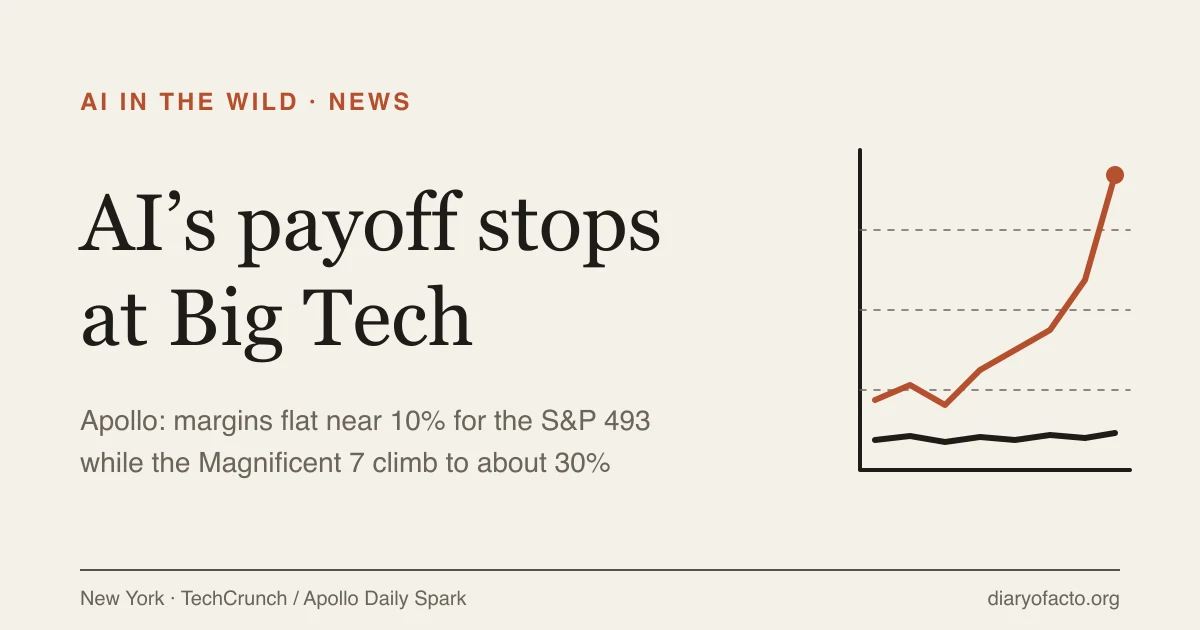
The AI payoff has not reached most of corporate America, according to an October 24, 2026 note from Torsten Slok, chief economist at Apollo Global Management. Revenue per worker and profit margins are flat for the 493 companies in the S&P 500 outside Big Tech, while both are climbing for the seven largest tech firms.
Apollo Finds No AI Payoff in S&P 493 Revenue Per Worker
Inflation-adjusted revenue per employee has barely moved for the S&P 493 since 2022, according to the first chart in Slok’s note, built from Bloomberg and Macrobond data. The S&P 493 is the index minus Alphabet, Amazon, Apple, Meta, Microsoft, Nvidia and Tesla. Apollo’s chart puts the seven tech companies at roughly $780,000 of revenue per employee in the latest quarter, up from about $565,000 at the start of 2023. The other 493 sit near $525,000, inside the band of about $500,000 to $550,000 they have occupied for four years. If AI were making the average large company’s staff more productive, this is the line where it would show first.
Profit Margins Outside Tech Have Stayed Near 10%
The S&P 493 profit margin has stayed at roughly 9% to 10% since 2023, according to Apollo’s second chart. Over the same stretch the Magnificent 7 margin rose from about 14% to about 30%. Slok’s third chart adds the economy-wide view. Utilization-adjusted total factor productivity, a San Francisco Fed series that strips out the business cycle, shows no AI-era acceleration and sits near zero in its latest reading.
Corporate AI Spending Is Concentrated in a Small Group of Firms
The top 10% of firms account for 99.5% of model serving and inference spending, according to data from Ramp chief economist Ara Kharazian that Apollo reproduces. The same group accounts for 95.6% of spending on OpenAI and Anthropic and 99% of spending on neoclouds. A second Ramp AI Index cut shows who those heavy spenders are. Among the top 1% of AI spenders, 80.4% are venture-backed companies. Among median spenders, 13.1% are. Apollo titles that chart as circularity in token spending. Slok writes that venture-backed companies keep spending more on tokens, while mainstream companies do not need the latest model and will not pay for it. Apollo says those mainstream companies have started to treat token spending as a cost center that weighs on margins.
Slok Argues Cheaper Models Will Not Close the Gap on Their Own
Falling model prices may not translate into higher revenue or margins outside tech, Slok wrote, because most business value comes from decisions that models handle poorly. “AI may be a great calculator, but in business, intelligence is mostly judgment,” he wrote. He lists accountability, trust, culture, unwritten rules, ethical trade-offs and fairness as things AI does not understand, and ties each one to reputational risk. His conclusion is that the AI story will be settled by the S&P 493. The note is an economist’s reading of aggregate data and does not measure any single company’s AI program.
Why This Matters for Engineering Leadership
Apollo’s note moves the AI conversation in a board meeting from adoption to unit economics. A CFO who reads it will ask what the token bill bought, and usage counts will not answer that question. The measures Slok uses are revenue per employee and margin, and an engineering organization can build its own version of each before the question arrives. Pick one workflow where AI spending is concentrated, such as code review, support triage or test generation. Record its cost per unit of output and its cycle time before the tool is rolled out, then track both monthly alongside the model and inference invoices. Report the workflow numbers next to the spend, so the budget review sees cost and outcome on the same page. Where the numbers do not move, cut the spend and say so. A team that can show which of its AI line items changed a unit cost keeps the ones that work. The rework that hides before deployment belongs in the same ledger, as we covered in AI rework that DORA metrics cannot see.
FAQ
Has AI paid off for companies outside Big Tech?
Not yet, according to Apollo chief economist Torsten Slok. His October 24, 2026 note finds revenue per worker and profit margins flat for the S&P 493 while both rise for the seven largest tech companies.
What is the S&P 493?
It is the S&P 500 minus Alphabet, Amazon, Apple, Meta, Microsoft, Nvidia and Tesla. Slok uses it to measure AI’s effect on mainstream corporate America.
How concentrated is corporate AI spending?
Very concentrated. Ramp data in Apollo’s note shows the top 10% of firms account for 99.5% of model serving and inference spending and 95.6% of spending on OpenAI and Anthropic.
Who are the biggest AI spenders?
Mostly venture-backed companies. In the Ramp AI Index data Apollo cites, 80.4% of the top 1% of AI spenders are VC-backed, against 13.1% of median spenders.
Is AI raising US productivity growth?
Apollo’s note says there is no sign of it yet. The San Francisco Fed’s utilization-adjusted total factor productivity series it charts sits near zero in the latest reading.