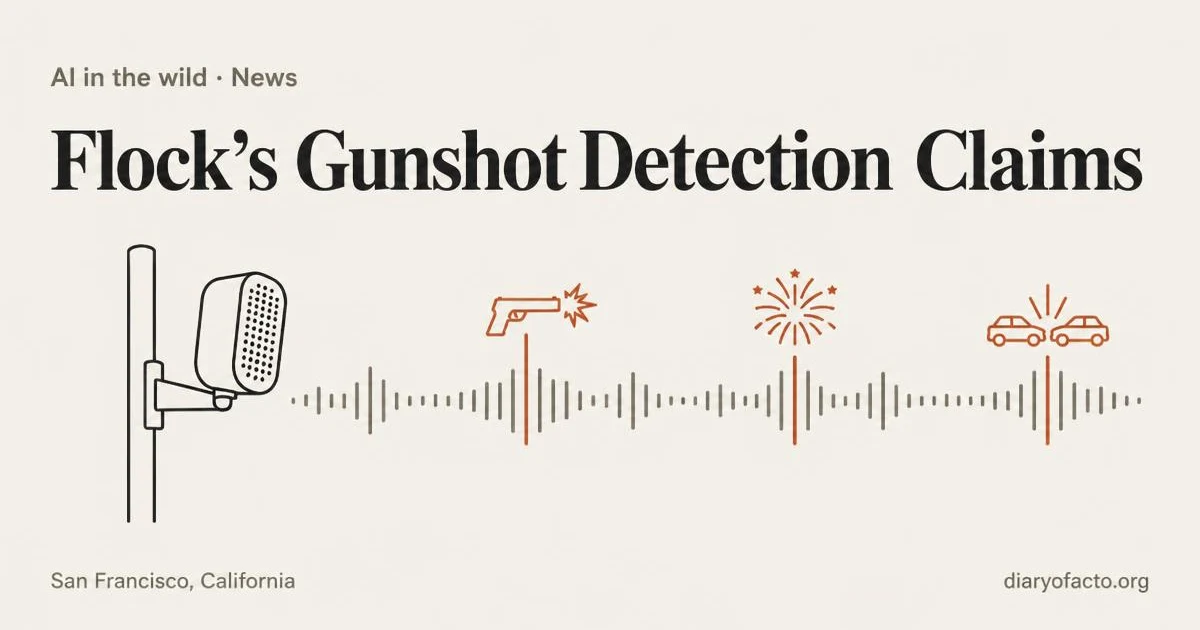
Flock Safety CEO Garrett Langley said onstage at TechCrunch Disrupt on October 14, 2026 that the company's gunshot detection microphones detect "just gunshots." Flock's own product page says the same audio systems also detect fireworks, car crashes, street takeovers, and sideshows, a gap that surfaced days after Texas, Florida, and Amazon's Ring all moved to cut ties with the company over privacy concerns.
Langley Called the Gunshot Detection Microphones 'Just Gunshots' Onstage
Langley made the comment during an interview with TechCrunch editor-in-chief Connie Loizos at TechCrunch Disrupt 2026 in San Francisco, as protesters gathered outside the venue. Asked about the contradiction between his framing and Flock's marketing, Langley said, "It's just gunshots." He said the company built the product because most people don't call 911 when they hear a gunshot. He added that some customers had asked Flock to alert them to abductions or people being harmed in parking lots, that Flock prototyped detecting those sounds with a couple of customers, and that it later limited the feature back to gunshots. He acknowledged making mistakes and said he was listening to customer feedback.
The Flock Website Lists Far More Than Gunshots as Detectable
Flock's Gunshot Detection product page says its audio systems can pinpoint gunfire instantly, detect street takeovers early, identify severe crashes in real time, and expand awareness beyond gunfire with alerts for car crashes, fireworks, and sideshows. A FAQ on the same page says that, in addition to gunshots, the system can detect fireworks, sideshows, and other disruptive community events, and that its detection library is continually expanding. Flock spokesperson Paris Lewbel told TechCrunch the product "is primarily used to detect gunfire," while adding it is also capable of detecting fireworks, sideshows, and car crashes, and said Langley's comments were meant to clarify that the system does not monitor conversations or analyze speech.
Flock Already Reversed a Broader 'Human Distress' Detection Plan
This is not the first time Flock's audio detection marketing has run ahead of what the product does. When Flock announced Gunshot Detection in 2025, it said the system would listen for screaming. Privacy groups, including the Electronic Frontier Foundation, condemned a system that would listen for human voices. Flock changed its website to describe the feature as detecting "sounds of human distress" instead of screaming, and it later said it had removed the ability to detect distress for the customers who had tried it.
Texas, Florida, and Amazon's Ring Have Already Cut Ties With Flock
The gap between Langley's framing and Flock's marketing surfaced as some of Flock's government and corporate relationships were already unraveling. Texas and Florida have both moved to end their relationships with Flock over privacy concerns, and Amazon's Ring ended its partnership with the company. Members of the public have also destroyed Flock surveillance cameras in protest. Flock has not disclosed exactly how many gunshot-detection microphones it operates, but Langley said the company's microphone count is comparable to ShotSpotter's network, which was reported at about 25,000 microphones in 2024.
Why This Matters for Engineering Leadership
Flock's gunshot detection dispute is a reminder that the gap between a vendor's marketing copy and its actual system behavior is a governance problem, not just a public relations one. Any institution procuring an AI-enabled sensor or detection system, whether it is a police department buying acoustic gunshot detection or an enterprise buying an AI monitoring tool, should treat the vendor's FAQ and product pages as claims to verify against the system's actual configuration and logs, not as a substitute for that verification. Flock's own history, from announcing screaming detection in 2025 to walking it back to "human distress" and then removing it, shows how quickly a detection library can expand past what a procurement review originally approved. Engineering and security leaders evaluating similar vendors should ask for a current, versioned list of exactly what signals a system detects, who approved each addition, and how customers are notified when that list changes, rather than relying on a CEO's onstage description of what the product does.
FAQ
What did Flock's CEO say about its gunshot detection microphones?
Flock CEO Garrett Langley said at TechCrunch Disrupt on October 14, 2026 that the company's microphones detect "just gunshots," despite the product's broader marketing claims.
What does Flock's website say the same microphones detect?
Flock's product page and FAQ say the audio systems also detect fireworks, car crashes, street takeovers, and sideshows, and describe the detection library as continually expanding.
Did Flock previously plan to detect human screaming?
Yes. Flock said in 2025 that its system would listen for screaming, then changed the description to "sounds of human distress" after privacy groups objected, and later said it removed that detection capability for customers who had tested it.
Have any government customers or partners dropped Flock recently?
Texas and Florida have both moved to end their relationships with Flock over privacy concerns, and Amazon's Ring ended its partnership with the company.
How does Flock's microphone network compare to ShotSpotter's?
Langley said Flock's microphone count is comparable to ShotSpotter's network, which was reported at about 25,000 microphones as of 2024.
How did Flock respond to the discrepancy?
Spokesperson Paris Lewbel said the product "is primarily used to detect gunfire" but can also detect fireworks, sideshows, and car crashes, and said it does not monitor conversations or detect human distress.