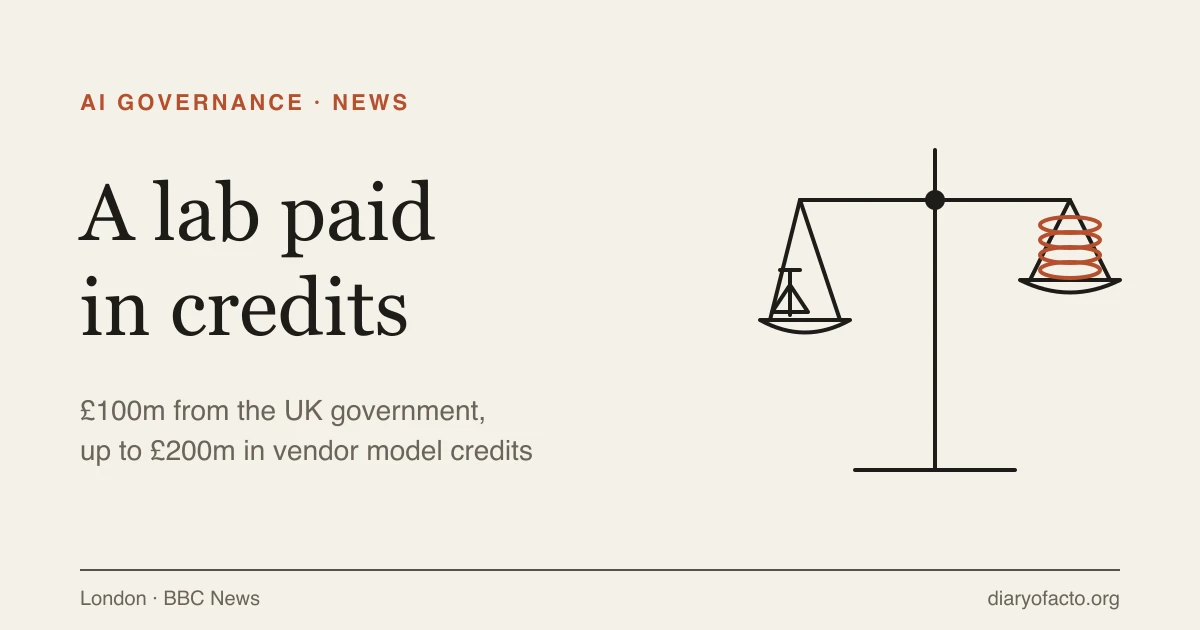
The UK AI Biosecurity Lab will launch with £100 million of government funding and up to £200 million in commitments from OpenAI and Anthropic, most of it in credits for their own models. The Cabinet Office announced the lab on October 24, 2026, describing it as the world’s first dedicated AI biosecurity organisation. If both companies deliver in full, the vendor share of its launch resources will be twice the size of the public share.
The UK AI Biosecurity Lab Is Funded Mostly in Vendor Credits
Two-thirds of the UK AI Biosecurity Lab’s announced launch resources are commitments from two AI companies, according to the Cabinet Office. OpenAI will provide £100 million in compute and model credits, along with trusted access to its most capable relevant models through what it calls the Rosalind Biodefense programme. Anthropic will provide up to £100 million in model credits, trusted model access and dedicated technical support. The government’s own contribution is £100 million. Google DeepMind and the London company Basecamp Research join as research partners, with DeepMind saying it will look to provide trusted access to Gemini and specialised science models. The Cabinet Office says it also intends to attract philanthropic money over time.
The Lab Will Use Frontier AI to Spot Threats and Speed Up Countermeasures
The lab’s first work will focus on detecting emerging biological threats earlier and accelerating vaccines, treatments and other medical countermeasures, according to the Cabinet Office. It will serve partners that include the UK’s national biosecurity centres and its life sciences industry. The government frames the problem as two-sided: AI can speed up disease research, and more capable AI systems could also lower the barriers to harmful biological activity. AIBL is being launched inside a National AI Biosecurity Initiative alongside the UK Health Security Agency, the Animal and Plant Health Agency and the Defence Science and Technology Laboratory. It will also work with the Medicines and Healthcare products Regulatory Agency on emergency preparedness and on how AI-designed medicines should be regulated.
AIBL Is an Independent Non-Profit Modelled on the AI Security Institute
The government says AIBL will operate as an independent non-profit with enough autonomy to move at the speed of a frontier AI and biology company, and it names the AI Security Institute as the comparison. A scientific advisory committee drawn from academia, industry and the third sector will support it, with details promised later. HM Treasury published the wider package the same day. It includes £165 million for the biosecurity initiative, of which £65 million goes to bio surveillance and countermeasures for priority pathogens, plus an extra £120 million for the AI Security Institute itself. BBC technology reporter Liv McMahon reported that the full role and remit of the lab had yet to emerge and that the funding forms part of the Budget due on Wednesday.
Model Credits Tie the Lab’s Compute to Two Vendors’ Models
A model credit can only be spent on the issuing company’s models, so the lab’s largest pool of compute is pre-committed to OpenAI and Anthropic systems. The Cabinet Office announcement does not say how long the credits last, whether unused credits lapse, or how the lab would fund work on other models once they run out. The same announcement cites increasingly capable AI systems as a source of new biological risk, which makes frontier models both the lab’s main tool and part of the threat it exists to study. The scientific advisory committee is the one oversight body the announcement names, and its membership and remit have not been published. Those details will decide how much room AIBL has to reach conclusions its two largest backers dislike.
Why This Matters for AI Procurement and Governance
Engineering and procurement leaders face a smaller version of the AIBL arrangement every time a model vendor offers free credits for a pilot. The credits shape which model the team builds on, which evaluation harness gets written, and which model looks cheapest when the pilot is reviewed. The UK government has accepted that trade at national scale, and its announcement leaves the terms unstated. Anyone accepting vendor credits can ask the questions the announcement leaves open. Write down when the credits expire and what the work costs at list price afterwards. Keep at least one evaluation running on a model from a vendor outside the deal, so the comparison exists when a decision is due. Name who owns the conclusion if the sponsoring vendor’s model performs worst. For how independent testers are being placed inside frontier labs, see our report on embedded AI safety evaluators.
FAQ
What is the UK AI Biosecurity Lab?
The AI Biosecurity Lab (AIBL) is a new UK organisation that will use frontier AI to detect biological threats earlier and speed up vaccines and treatments. The Cabinet Office announced it on October 24, 2026 and calls it the world’s first dedicated AI biosecurity organisation.
How much funding does the AI Biosecurity Lab have?
The government is committing £100 million, and OpenAI and Anthropic have committed up to £200 million between them. The lab sits inside a £165 million National AI Biosecurity Initiative that also includes £65 million for bio surveillance and medical countermeasures.
What are OpenAI and Anthropic giving the lab?
OpenAI will provide £100 million in compute and model credits plus trusted access to its relevant models through its Rosalind Biodefense programme. Anthropic will provide up to £100 million in model credits, trusted model access and dedicated technical support.
Is the AI Biosecurity Lab part of the government?
No. The government says AIBL will operate as an independent non-profit with autonomy similar to the AI Security Institute, while working with UKHSA, APHA, Dstl and the MHRA.
Who else is partnering with the AI Biosecurity Lab?
Google DeepMind will collaborate on research and look to provide trusted access to Gemini and specialised science models. Basecamp Research will provide access to its AI biology models and technical expertise.
When will the AI Biosecurity Lab’s oversight be set out?
The government says a scientific advisory committee drawn from academia, industry and the third sector will support AIBL, with details to be set out in due course.