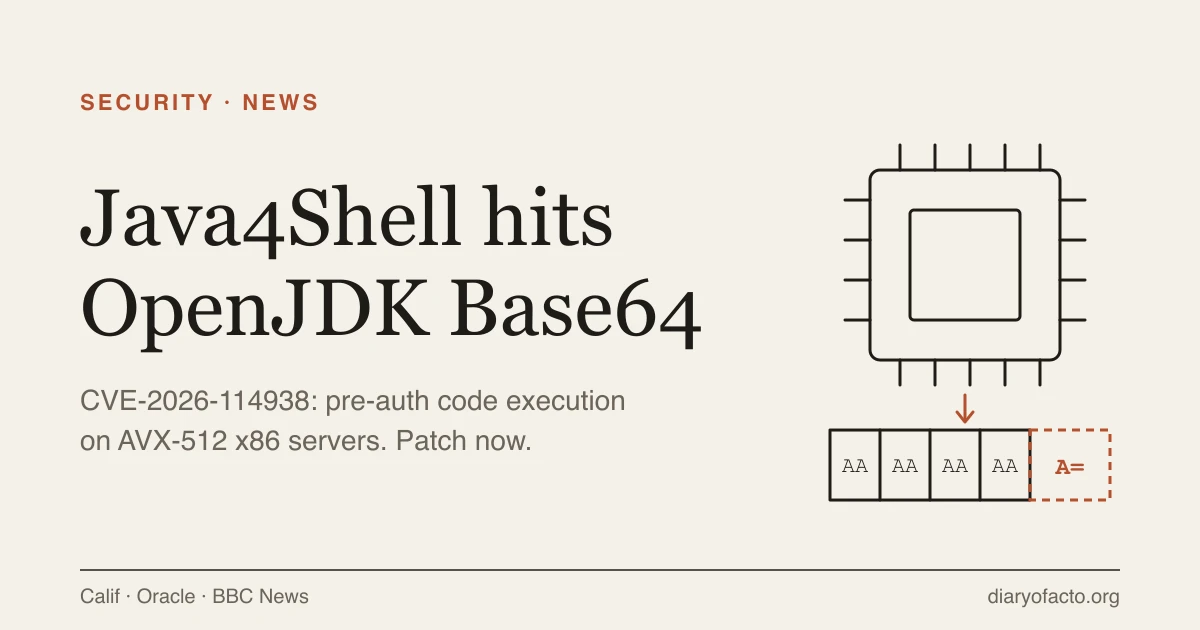
Java4Shell is a memory-corruption flaw in OpenJDK’s Base64 decoder, tracked as CVE-2026-114938, that lets a remote attacker overwrite heap memory and, with enough work, run code on the server. Oracle and the OpenJDK project released fixes on November 17, 2026, the day the security firm Calif disclosed it, and every Java runtime on an affected x86-64 server should be updated now.
Java4Shell Lives in Assembly Code Written to Make Base64 Decoding Faster
The flaw sits in an intrinsic, a block of hand-written machine code that the HotSpot JIT compiler swaps in for a hot Java method. On x86-64 processors that support AVX-512 VBMI instructions, OpenJDK decodes Base64 with this routine to process many bytes at once. Calif’s write-up says the routine mishandles the padding character at the end of a short input. For a string of 64 A characters followed by a single equals sign, it computes a negative output length, which the processor then treats as permission to write all 64 bytes of a block. Java allocates a 50-byte array for that input, so 62 bytes land past its end. Java eventually throws an exception and rejects the input, but by then the neighboring objects in memory have already been overwritten. On older OpenJDK 17 builds the trigger is 128 A characters and an equals sign.
Calif Reached Pre-Auth Code Execution in Jira, Jenkins and Keycloak
Calif says it demonstrated remote code execution without credentials against default configurations of Keycloak, Atlassian Jira, Atlassian Confluence, JFrog Artifactory, Jenkins and PingFederate. It reached code execution after authentication in Apache Kafka brokers, Apache Solr, Elasticsearch, Gerrit and Spinnaker, and in sample applications built on Spring Boot and Apache Struts. Ordinary features such as login and file upload pass attacker-supplied text to the Base64 decoder. Calif also reports a client-side variant, shared with it by the researcher samczsun, in which a Java program is compromised by opening a TLS connection to a malicious server. Calif is withholding its product-specific exploit chains until users have had time to upgrade, and it says each target needs a bespoke exploitation profile. BBC News reported that it was unclear whether any company had been affected.
The Flaw Needs an AVX-512 Server CPU and OpenJDK 17.0.6 or Newer
Calif says Java4Shell affects OpenJDK 17.0.6 and later, which covers the builds most companies run: Amazon Corretto, Eclipse Temurin, the Microsoft Build of OpenJDK, Azul Zulu, BellSoft Liberica, SAP SapMachine, Red Hat OpenJDK, Oracle OpenJDK, Oracle Java SE and Oracle GraalVM for JDK. Oracle’s advisory lists Java SE 8u511b33-perf, 17.0.21.0.3, 21.0.13.0.3, 25.0.5.0.3 and 27.0.1.0.3 as affected versions. The vulnerable path only runs on x86-64 chips with AVX-512 VBMI, which Calif says includes Intel Xeon Ice Lake, Sapphire Rapids, Emerald Rapids and Granite Rapids, and AMD EPYC and Ryzen from Zen 4 onward. ARM64 machines are not affected. That makes the hardware fleet part of the exposure question, since the same container image can be vulnerable on one instance type and safe on another.
Oracle and Calif Score Java4Shell Differently
Calif rates the flaw 9.2 out of 10 under CVSS 4.0. Oracle’s November 2026 Critical Security Patch Update, which carries 11 Java SE fixes, rates it 8.1 under CVSS 3.1, marking it remotely exploitable without authentication but with high attack complexity. Oracle’s note on the issue says it applies to deployments that pass data to the affected component’s APIs, such as through a web service. The gap reflects how hard exploitation is in practice. Calif’s own limitations section says some of its techniques depend on streaming partial request bodies, and that nginx’s default request buffering breaks those particular chains, though it does not stop the Elasticsearch chain.
One Researcher and an AI Coding Agent Found It in About an Hour
Calif credits researcher Quang Luong, who writes that he directed OpenAI’s Codex at the HotSpot JIT compiler, intrinsics and cryptography code and discarded weak findings until the Base64 bug surfaced. Calif says discovery took about an hour, the first working exploit took two more, and total token spend was under $200. The same firm disclosed PHP2Shell, a flaw in PHP, in October. Its write-up ends by arguing that teams should use the same tools to strip out code they never needed, and asks “What can we delete?”
Why This Matters for Engineering Leadership
By Calif’s account, Java4Shell is a flaw in an optimization that most affected applications never needed, shipped to everyone because it was on by default. The patch is the first job, and it is a runtime job, which means it lands with whoever owns base images, not with the teams who own the applications. Ask for three lists this week: every JVM version running in production, the CPU family under each, and which of those services accept Base64 from the internet through login, upload or API tokens. Where a runtime cannot be updated quickly, the -XX:-UseBASE64Intrinsics flag removes the vulnerable path and is safe on ARM, while the alternative -XX:UseAVX=2 flag will stop the JVM from starting there. The longer lesson is about discovery speed. A single researcher with a coding agent found and weaponized a flaw in the most widely used Java runtime in an afternoon for under $200. Patch windows planned around quarterly vendor cycles assume attackers move slowly, and that assumption no longer holds.
FAQ
What is Java4Shell?
Java4Shell is CVE-2026-114938, a memory-corruption flaw in OpenJDK’s x86-64 Base64 decoder. Malformed Base64 input can overwrite heap memory and, with further work, lead to remote code execution.
Which Java versions does Java4Shell affect?
Calif says OpenJDK 17.0.6 and newer, including builds such as Amazon Corretto, Eclipse Temurin and Azul Zulu. Oracle lists Java SE 8u511b33-perf, 17.0.21.0.3, 21.0.13.0.3, 25.0.5.0.3 and 27.0.1.0.3 as affected.
Does Java4Shell affect ARM servers?
No. The vulnerable code only runs on x86-64 processors with AVX-512 VBMI support, such as Intel Xeon Ice Lake and later or AMD Zen 4 and later. Calif says ARM64 CPUs are not affected.
How do I mitigate Java4Shell if I cannot patch yet?
Start the JVM with -XX:-UseBASE64Intrinsics, or with -XX:UseAVX=2 on x86-64 hosts only. Calif warns that OpenJDK on ARM does not recognize the second flag and will fail to start.
How severe is Java4Shell?
Calif scores it 9.2 under CVSS 4.0. Oracle scores it 8.1 under CVSS 3.1, rating attack complexity high and requiring no authentication.
How was Java4Shell found?
Calif researcher Quang Luong found it using OpenAI’s Codex. Calif says discovery took about an hour, the first working exploit two more hours, and under $200 in tokens.