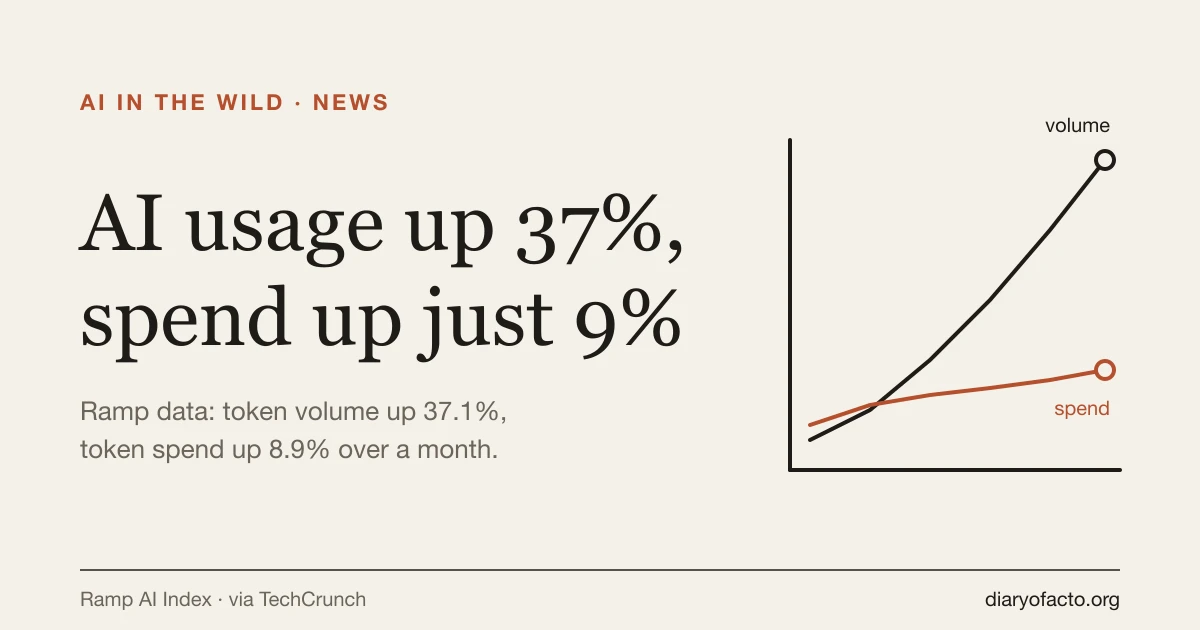
AI token spending among businesses on Ramp rose 8.9% in the week ending October 23, 2026 compared with the same week a month earlier, while the number of tokens those businesses consumed rose 37.1%. Usage is climbing about four times faster than the bill, and Ramp’s lead economist Ara Kharazian attributes the gap to falling model prices and to customers who have learned to control what they spend.
Ramp’s AI Token Spending Data Shows Volume Rising Four Times Faster Than Spend
The weekly figures come from the public Ramp AI Index, which tracks AI adoption and spending using card, invoice and ACH transactions from more than 85,000 American businesses. The token measures draw on a narrower group: Ramp customers that connect their AI providers to its Token Spend Management product. Ramp says that group is not representative of its total AI spend, and that the results point in the same direction. In his October 14 letter, Kharazian reported two consecutive months, August and September, of almost no growth in token spend, even as token volumes kept rising. He wrote that the pattern was not seasonal. TechCrunch’s Rebecca Bellan reported on November 6 that token spend had grown 42% month on month in July, which makes the late-summer flattening sharper. Spend did pick up in October, reaching a new peak that Kharazian put at 1.5% above the August high.
The Heaviest AI Spenders Are Paying Slightly Less Per Employee Than in July
Ramp’s data has long shown that a small group of firms drives most of the money. Kharazian has previously reported that 80% of spend on OpenAI and Anthropic comes from the top 1% of firms. That group spent $9,568 per employee per month in September, 3.1% below its July high of $9,873, even though overall per-employee spend rose 11.7% that month. The median paying firm spends $15.70 per employee per month, according to the index. Kharazian told TechCrunch that a stall among the top 1% is enough to slow total revenue for model companies, because growth at the median and the top 10% is too small to make up the difference. Adoption itself is near saturation by his reading. In September, 55.9% of Ramp businesses paid for AI, up 0.6 percentage points from August, and he wrote that the market appears to be at the top of its S-curve.
Price Cuts and Buyer Cost Controls Explain the Flat AI Token Bill
Kharazian names lower prices at the frontier as the main driver, along with cheaper, better models at every level of capability. OpenAI halved API prices for its GPT-6 Sol and GPT-6 Luna models in September, and TechCrunch reports that Anthropic has made large price reductions of its own. The second factor is the buyer. Kharazian told TechCrunch that experienced AI users set defaults that keep expensive models away from long-running tasks, put budgets on employees, and use routers to send work from standard models to cheaper light ones. His summary to TechCrunch was blunt: “You can use more AI, but use it for less.” He also wrote that enterprise contracts with OpenAI and Anthropic favor the customer. The deals he has heard about rarely assume unusually high spend, and the labs offer discounts off list price to close them. Notion co-founder Akshay Kothari posted internal data showing the same pattern of rising tokens and contained costs, according to TechCrunch.
Why This Matters for Engineering Leadership
Ramp’s numbers are evidence that AI cost controls work at company scale. The firms with the most AI usage are the ones holding spend flat, and Kharazian credits specific engineering decisions: default model choices, per-person budgets and routing. If your AI bill is rising in step with usage, that is a sign those controls are missing. Start with the cheap ones. Set the default model for agents and long-running jobs to the least expensive one that passes your evaluations, and require a reason to override it. Give teams a token budget and show them their own spend each week. Put a router in front of classification and yes-or-no tasks before anyone asks for a bigger contract. The contract point matters for procurement too. Ramp’s economist describes a buyer’s market, with list prices falling and discounts on offer, so a multi-year commitment sized to today’s usage at today’s rates is likely to overpay. Measure cost per completed task, and renegotiate when the per-token price moves. The usage your teams generate will keep growing. The bill should only grow when the work it buys does.
FAQ
Is AI token spending slowing down?
Growth has slowed sharply. Ramp recorded two straight months of almost no growth in token spend in August and September 2026, and spend rose 8.9% in the week to October 23 while volume rose 37.1%.
Why is AI token spending growing slower than usage?
Ramp’s Ara Kharazian points to falling prices for frontier models and cheaper models across the board. He also says heavy users are getting better at controlling spend with defaults, budgets and routers.
How much do companies spend on AI per employee?
Ramp puts the median paying firm at $15.70 per employee per month. The top 1% of firms spent a median of $9,567.53 per employee per month in September 2026.
Which AI company leads business token spending on Ramp?
Anthropic held 60.5% of token spending among Ramp businesses in the week ending October 23, 2026. By adoption, 43.8% of Ramp businesses paid Anthropic in September and 40.6% paid OpenAI.
Are enterprise AI contracts locking customers into higher spend?
Kharazian wrote on October 14 that customers hold the stronger negotiating position. He says the contracts he has heard about rarely assume above-normal spend and often come with discounts off list price.
How reliable is the Ramp AI Index token data?
The token figures come from Ramp businesses using its Token Spend Management product, which Ramp says is not representative of its total AI spend. Ramp says the results are directionally similar.